How to assess optimization, orchestration, integration, and human oversight before choosing a platform.
Not long ago, optimizing a chemical reaction or a new material meant weeks, or even months, at the bench, adjusting one variable at a time, hoping experience and intuition would eventually converge on something “good enough.” Today, AI-driven experiment design and autonomous lab platforms promise a different reality: faster convergence, fewer wasted runs, and decisions grounded in data.
The shift is real, but so is the complexity of choosing a platform to support your specific needs. You don’t want to end with just a software product. You want to turn ideas into discovery and make the possibilities of “exponential science” happen.
SDLabs® has helped many teams transition into structured, AI-driven R&D, yet no two labs operate under the same constraints, budgets, automation levels, or scientific goals. This evaluation maps the current landscape, focusing on the technical pillars and practical bottlenecks that define modern research.
The shift is real, but so is the complexity of choosing a platform to support your specific needs. You don’t want to end with just a software product. You want to turn ideas into discovery and make the possibilities of “exponential science” happen.
SDLabs® has helped many teams transition into structured, AI-driven R&D, yet no two labs operate under the same constraints, budgets, automation levels, or scientific goals. This evaluation maps the current landscape, focusing on the technical pillars and practical bottlenecks that define modern research.
Main Takeaways
There is no universal “best” platform, only the one that aligns with your data maturity, automation level, and scientific goals. True innovation isn’t just about individual autonomy, it’s about creating a foundation of shared knowledge that sustains high-performance R&D and accelerates scientific discovery.
The Evolution of Bayesian Optimization
Bayesian optimization (BO) changed scientific search because it thrives where traditional methods struggle: high-dimensional, nonlinear spaces with mixed variables and competing objectives. While classical DoE still has a place, it breaks down as the search space grows. BO turns each experiment into information and uses that information to choose the next move. This logic becomes more powerful when embedded in a closed-loop AI workflow.
- The Bottleneck: Many tools still treat every project like a cold start, ignoring historical context, experimental knowledge, and practical constraints that may be sitting unused.
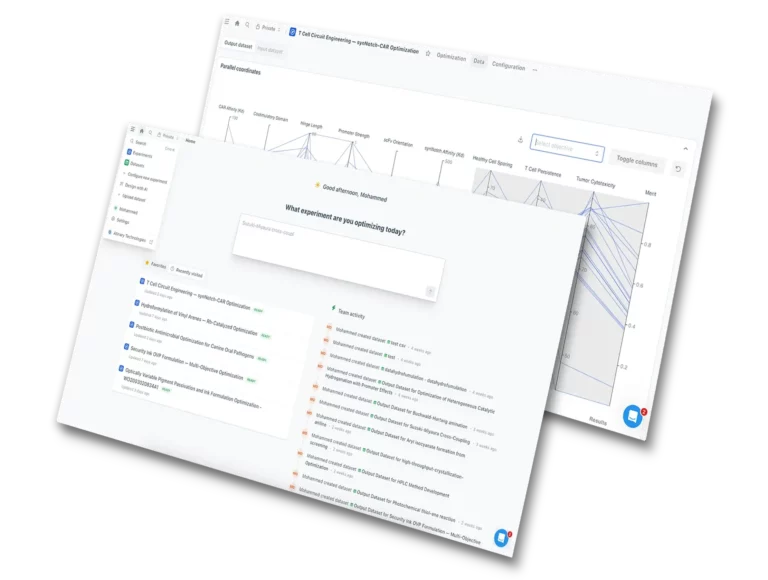
- The Atinary Approach: A stronger platform should do more than optimize an objective. It should understand chemical feasibility and can incorporate prior knowledge without forcing users to become data scientists. SDLabs extends standard BO with knowledge-aware search, constraint handling, and a code-free interface designed for bench scientists, such that it is easy to integrate with existing workflows.
Open-source vs proprietary performance
Open-source tools are valuable for academic prototyping, early testing, and proof-of-concept work. However, the transition to wider-scale use across an organization often reveals hidden burdens.
- The Bottleneck: “Free” software is not exactly free if it consumes internal engineering for maintenance, creates security risks, or lacks the stability and scalability for repeatable R&D. Support and deployment often shift onto the internal IT and data science teams. What looked lightweight at first can become a long-term engineering project.
- The Atinary Approach: Scalability discovery and development requires secure handling of proprietary data that can be rolled out across a department, not just used by one expert who knows how to keep the tool alive. SDLabs is designed for quick onboarding for users and enterprise-grade deployment.
Agentic Workflows and Orchestration
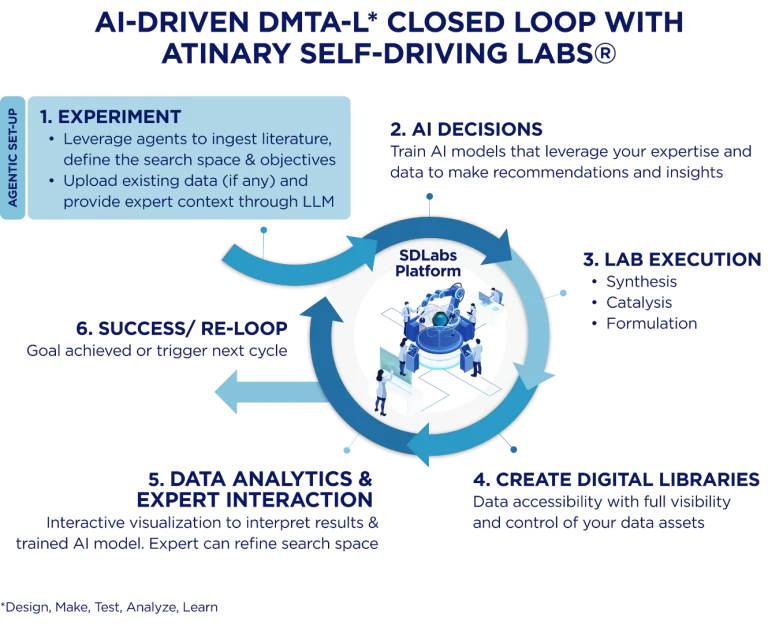
Automation used to focus on the body of the lab (robots, handlers, instruments, etc.). That still matters, but it is no longer enough. The shift is toward the brain of the workflow, and augmenting scientists and the labs to integrate both AI and robotics, which is the core of the Self-Driving Labs® approach. A software, beyond just calculating a recommendation, also orchestrates the next action.
- The Bottleneck: Automation without intelligence. If a system depends on a specialist to rewrite logic every time a project changes direction, it adds friction instead of progress.
- The Atinary Approach: Our platform orchestrates the entire learning loop (defining objectives, prioritizing experiments, and updating models automatically) so the scientist can focus on the “why”. The intuitive, code-free interface utilizes agentic workflows to handle the “how” of the search, including scanning literature, extracting key information, and setting up the design of experiments. This shift allows scientists to focus on interpretation.
Integration: Hardware-Agnostic Connectivity
Another common bottleneck in R&D is vendor lock. If a software is tied too tightly to one robotic stack, the lab loses flexibility to use the instruments they already own.
- The Bottleneck: Most labs are mixed environments. Some steps are manual, some are semi-automated with different islands of equipment, and some are fully robotic.
- The Atinary Approach: Hardware-agnostic connectivity. By connecting through APIs to existing instruments, LIMS, ELNs, and automation systems, SDLabs adapts to the lab’s existing state and preserves or augments digital continuity as the lab evolves. This allows teams to move toward Self-Driving Labs gradually, without forcing a full hardware replacement.
This matters because integration is not just an IT issue. It determines how quickly a platform can be adopted, how much rework it creates, and whether the learning loop survives real-world lab complexity.
“Human-in-the-Loop” Essential
The goal is to accelerate science by augmenting scientists, not replacing them. Today, many talented researchers still spend the majority of their time on repetitive tasks, running experiments, recording results, and managing laboratory workflows, stripping away the high-level strategy, creativity, and ingenuity that only a scientist can provide. By automating repetitive tasks and incorporating agentic workflows, we allow researchers to return to the high-level strategy layer where their expertise is most valuable.
“It’s very important for scientists to realize that this is a tool that will really leverage their time. It’s not a replacement. It’s an enhancer or productivity enhancer.”
– Loïc Roch (Co-Founder and CTO).
Scientists bring context, judgment, exceptions, and practical trade-offs that no model understands on its own. A good platform makes that expertise easier to apply by showing its logic clearly, allowing users to adjust constraints, and keeping the workflow readable from the bench. A code-free interface helps, but transparency matters just as much.
SDLabs is built around that human-in-the-loop model. It is meant to make AI legible and usable at the bench, not hidden behind a black box. The result is a system that supports faster decisions without asking the scientist to give up control.
SDLabs is built around that human-in-the-loop model. It is meant to make AI legible and usable at the bench, not hidden behind a black box. The result is a system that supports faster decisions without asking the scientist to give up control.
Final thoughts on choosing an AI platform
Labs differ in data maturity, automation level, budget, and scientific goals.
How to Evaluate Your Options:
How to Evaluate Your Options:
- Pilot Before Committing: Test the platform against your specific experimental setups and workflows.
- Prioritize Knowledge Retention: Ensure the system turns every experiment (success or failure) into a data flywheel.
- Assess Integration: Will the software fit your existing LIMS/ELN ecosystem?
Atinary is committed to a new standard for R&D. We help organizations move from manual, human-driven processes to fully digitized, AI- and data-driven R&D. Our platform is designed to solve the complex multi-objective challenges in formulation, synthesis, and catalysis, identifying global optima faster and more cost-effectively than traditional methods. By avoiding expensive, unnecessary experiments, we increase ROI and allow scientists and teams to collapse discovery cycles from years or decades into just weeks.
Atinary focuses on human-in-the-loop optimization and enterprise security for teams that need repeatable, scalable workflows.
Imagine a world where scientific breakthroughs are not rare events but a constant stream of discovery. Welcome to the era of Exponential Science.
Atinary focuses on human-in-the-loop optimization and enterprise security for teams that need repeatable, scalable workflows.
Imagine a world where scientific breakthroughs are not rare events but a constant stream of discovery. Welcome to the era of Exponential Science.
Author Contributions
Edlyn Wu, PhD (Scientific Solutions Associate)
Mohammed Azzouzi, PhD (Applications Engineer)
Edlyn Wu, PhD (Scientific Solutions Associate)
Mohammed Azzouzi, PhD (Applications Engineer)
About Atinary
Atinary, the pioneers of Self-Driving Labs®, builds intelligent solutions that unite AI, robotics, and human expertise to accelerate the development of molecules and materials. We enable Exponential Science by collapsing discovery cycles from years into weeks.
Atinary, the pioneers of Self-Driving Labs®, builds intelligent solutions that unite AI, robotics, and human expertise to accelerate the development of molecules and materials. We enable Exponential Science by collapsing discovery cycles from years into weeks.