
Unlock AI-driven insights and clearer decisions while staying focused on the lab, not the script. This guide shows you how to use advanced optimization tools without having to learn how to code.
Bench chemistry has long relied on cycles of intuition, manual setup, and incremental tweaks. While this approach works for simple, low-dimensional problems, it struggles to navigate modern reaction spaces where catalysts, ligands, solvents, temperature, and pressure interact in complex ways.
Advanced optimization tools are transforming the laboratory by converting each experiment into reusable learning. By integrating artificial intelligence and agentic workflows into daily R&D, scientists can move beyond trial-and-error to unlock clearer decisions and faster discoveries — all without needing to write code.
Advanced optimization tools are transforming the laboratory by converting each experiment into reusable learning. By integrating artificial intelligence and agentic workflows into daily R&D, scientists can move beyond trial-and-error to unlock clearer decisions and faster discoveries — all without needing to write code.
Key Takeaways
- AI tools augment bench decision-making; they do not replace chemists.
- Sample-efficient optimization reduces experiments, time, and materials.
- Useful AI and agentic workflows work with modest initial data and integrate into existing workflows.
- Human oversight, uncertainty metrics, and secure deployment are non-negotiable.
Main Takeaway
AI turns experiments into a continuous learning cycle: design → test → make → analyze → learn. Bench chemists define constraints and objectives, while AI proposes informative next runs. Then, the team validates and interprets. Discovery becomes a flywheel that learns from and improves with every experiment. The result is faster, cheaper, and more reproducible experimentation.
Traditional chemistry optimization bottleneck
In a typical R&D lab, researchers adjust one condition at a time, iterating until a result is good enough. In drug discovery and complex chemical workflows, this can require hundreds of experiments because subtle interactions are found only by chance.
By contrast, artificial intelligence (AI)-powered workflows use probabilistic models (like Gaussian processes) that learn patterns in the data. After each batch of experiments, the model predicts which untested conditions are most promising, balancing exploration and exploitation. This Bayesian optimization (BO) strategy dramatically shrinks the needed data.
As if that weren’t enough, in labs where optimization already demands hundreds of experiments, fragmented records make the problem worse — without structured digital R&D, hard-won insights from each run are lost. This converges, creating long-term organizational risk and forcing teams to relearn what they already discovered.
AI optimization delivers the greatest impact in areas where experimental spaces are large, multi-variable, and expensive to explore. This includes reaction optimization, catalysis, process chemistry, and formulation development (e.g., polymers, food, or coatings), as well as parts of drug discovery where prioritizing candidates or conditions is critical. In these contexts, AI helps reduce the number of experiments needed while improving decision quality across complex trade-offs.
By contrast, artificial intelligence (AI)-powered workflows use probabilistic models (like Gaussian processes) that learn patterns in the data. After each batch of experiments, the model predicts which untested conditions are most promising, balancing exploration and exploitation. This Bayesian optimization (BO) strategy dramatically shrinks the needed data.
As if that weren’t enough, in labs where optimization already demands hundreds of experiments, fragmented records make the problem worse — without structured digital R&D, hard-won insights from each run are lost. This converges, creating long-term organizational risk and forcing teams to relearn what they already discovered.
AI optimization delivers the greatest impact in areas where experimental spaces are large, multi-variable, and expensive to explore. This includes reaction optimization, catalysis, process chemistry, and formulation development (e.g., polymers, food, or coatings), as well as parts of drug discovery where prioritizing candidates or conditions is critical. In these contexts, AI helps reduce the number of experiments needed while improving decision quality across complex trade-offs.
Evolving the Bench Work: From Tools to Agentic Workflows
Today, Atinary’s SDLabs AI platform has evolved from a recommendation engine into a comprehensive agentic workflow. This means the system doesn’t just analyze data—it actively assists in the “thinking” and “doing” phases of research.
Autonomous Hypothesis Generation: AI agents can now ingest relevant literature and prior data to propose initial search spaces and suggest parameter bounds.
Intelligent Screening: The platform performs multivariate screening across continuous (temperature), discrete (equivalents), and categorical (solvents) variables simultaneously.
Agentic Decision Loops: Our code-free agentic platform handles the “how” of the search-scanning literature, setting up the design of experiments, recommending the next move, and allowing scientists to focus on the “why”.
Physical AI & Closed-Loop Discovery: In our Self-Driving Labs®, the next experiment is not just suggested: it is queued, executed by robotics, and the results are fed back into the model without manual handoff. This physical AI integration provides a working blueprint for fully autonomous discovery.
In an AI-augmented workflow, chemists begin by defining the goal and constraints: maximize yield, improve selectivity, reduce catalyst loading, lower cost, or balance multiple objectives simultaneously. The platform then designs multivariate experiments across continuous (temperature, time), discrete (equivalents), and categorical variables (solvent, ligand, catalyst). Unlike traditional screening, it does not explore blindly. It models the chemical space probabilistically and recommends the next most informative experiments.
Autonomous Hypothesis Generation: AI agents can now ingest relevant literature and prior data to propose initial search spaces and suggest parameter bounds.
Intelligent Screening: The platform performs multivariate screening across continuous (temperature), discrete (equivalents), and categorical (solvents) variables simultaneously.
Agentic Decision Loops: Our code-free agentic platform handles the “how” of the search-scanning literature, setting up the design of experiments, recommending the next move, and allowing scientists to focus on the “why”.
Physical AI & Closed-Loop Discovery: In our Self-Driving Labs®, the next experiment is not just suggested: it is queued, executed by robotics, and the results are fed back into the model without manual handoff. This physical AI integration provides a working blueprint for fully autonomous discovery.
In an AI-augmented workflow, chemists begin by defining the goal and constraints: maximize yield, improve selectivity, reduce catalyst loading, lower cost, or balance multiple objectives simultaneously. The platform then designs multivariate experiments across continuous (temperature, time), discrete (equivalents), and categorical variables (solvent, ligand, catalyst). Unlike traditional screening, it does not explore blindly. It models the chemical space probabilistically and recommends the next most informative experiments.
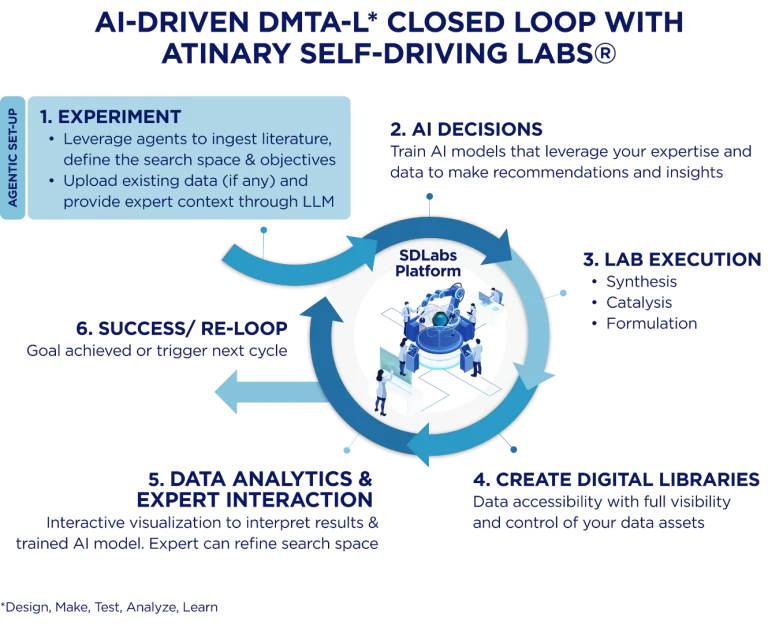
Instead of exhaustively testing combinations, AI performs intelligent screening of chemical space to converge toward global optima much faster. It handles Pareto optimization when multiple objectives compete. It integrates physicochemical descriptors to capture deeper structure–property relationships.
After each experimental batch, results are uploaded, and the model is updated. Advanced data analysis and visualization tools reveal trends and refine the search space. The system then recommends the next set of conditions, balancing exploration of uncertainty with exploitation of promising regions. Chemists review, select, and execute. Control remains human; iteration speed becomes algorithmic.
After each experimental batch, results are uploaded, and the model is updated. Advanced data analysis and visualization tools reveal trends and refine the search space. The system then recommends the next set of conditions, balancing exploration of uncertainty with exploitation of promising regions. Chemists review, select, and execute. Control remains human; iteration speed becomes algorithmic.
Beyond numerical optimization, AI agents can ingest relevant literature, propose initial search spaces, and help define objectives grounded in prior art. Large language models can summarize experimental rationale, suggest parameter bounds, propose alternative synthetic routes, or contextualize findings.
Crucially, AI-driven insights make recommendations interpretable. Lab scientists then see which variables most influence performance, understand trade-offs, and validate decisions. The loop becomes clearer and more productive.
The simple formula:
Design → AI decision → Experiment → Data analytics → Refined design → Success.
Design → AI decision → Experiment → Data analytics → Refined design → Success.
What data do AI optimization tools need?
Effective AI-guided optimization relies on the quality of the “ground truth”—the experimental data used to train the models. Below is an example of a digital backbone in the design of experiments:
Minimal inputs for a useful campaign
While requirements vary by project, a high-impact campaign can track these variables to ensure the ML models can learn effectively:
Minimal inputs for a useful campaign
While requirements vary by project, a high-impact campaign can track these variables to ensure the ML models can learn effectively:
| Experimental conditions | Measured outcomes | Metadata | Constraints and rules | Categories |
|---|---|---|---|---|
| · Temperature · Time · Concentration · Equipment notes · Protocol version | · Yield · Selectivity · Conversion · Impurity levels · Mass/volume units | · Operator · Exact procedure · Deviations · Timestamps | · Safety limits · Incompatible reagent pairs · Maximum catalyst loading | · Solvent · Ligand · Catalyst identity · Reactor mode |
Practical habits for success
Start with a small, diverse seed set of experiments, roughly 5–20 runs, to give the model coverage. Log every run in a machine-readable form so results attach to conditions. Record failed experiments. Negative results often teach more than hits.
What the tool must support
Modern optimization platforms must handle mixed variable types — continuous, discrete, and categorical — in the same campaign. They must run multi-objective searches and return Pareto trade-offs across yield, cost, and sustainability. They must accept domain constraints as hard limits and reuse historical project data to shorten new campaigns.
SDLabs™ adapts to where you are. With no prior data, the platform seeds itself from the first runs and begins learning immediately. With a small, focused dataset, it refines recommendations experiment by experiment. When teams run HTE plates (24-, 48-, 96-well), SDLabs™ ingests parallel batch inputs natively and updates the surrogate across multiple data points per cycle. The outcome: fewer wasted runs, preserved institutional knowledge, and faster convergence on robust operating points.
Start with a small, diverse seed set of experiments, roughly 5–20 runs, to give the model coverage. Log every run in a machine-readable form so results attach to conditions. Record failed experiments. Negative results often teach more than hits.
What the tool must support
Modern optimization platforms must handle mixed variable types — continuous, discrete, and categorical — in the same campaign. They must run multi-objective searches and return Pareto trade-offs across yield, cost, and sustainability. They must accept domain constraints as hard limits and reuse historical project data to shorten new campaigns.
SDLabs™ adapts to where you are. With no prior data, the platform seeds itself from the first runs and begins learning immediately. With a small, focused dataset, it refines recommendations experiment by experiment. When teams run HTE plates (24-, 48-, 96-well), SDLabs™ ingests parallel batch inputs natively and updates the surrogate across multiple data points per cycle. The outcome: fewer wasted runs, preserved institutional knowledge, and faster convergence on robust operating points.
AI tools used in chemistry optimization
AI in process chemistry and materials science is not a single tool. It is an entire ecosystem. And understanding the categories helps teams avoid overengineering or underestimating what they need.
Most bench chemists will want to adopt a code-free or open-source optimization platform. This allows scientists to define variables, objectives, and constraints. The advantages of using code-free tools are that scientists can quickly integrate them into their workflow. Instead of building a BO workflow from scratch — which requires statistical knowledge, coding experience, and time to validate — they can deploy an optimization environment in hours. For labs with limited IT appetite, strong UI and fast deployment are decisive advantages. And without having the chemists write scripts, or learn how to code to deploy ML algorithms.
Under the surface, many of these platforms rely on BO engines. As labs mature, orchestration and integration layers become critical. APIs, SDKs, and structured documentation enable connection with robotics platforms, ELNs, LIMS, and analytical systems. This turns optimization from a standalone exercise into a repeatable, scalable pipeline.
Finally, visualization and diagnostics determine whether chemists trust the system. Uncertainty maps, predicted-versus-observed plots, Pareto fronts, and design-space visualizations make the model interrogable. When recommendations are shown alongside reasoning — highlighting where uncertainty is high and which regions remain unexplored — AI becomes decision support.
The right combination depends on lab maturity. Manual labs prioritize usability and clarity. Semi-automated labs add integration. Fully robotic environments require orchestration and data infrastructure. The tool stack should match the lab, not the other way around.
Most bench chemists will want to adopt a code-free or open-source optimization platform. This allows scientists to define variables, objectives, and constraints. The advantages of using code-free tools are that scientists can quickly integrate them into their workflow. Instead of building a BO workflow from scratch — which requires statistical knowledge, coding experience, and time to validate — they can deploy an optimization environment in hours. For labs with limited IT appetite, strong UI and fast deployment are decisive advantages. And without having the chemists write scripts, or learn how to code to deploy ML algorithms.
Under the surface, many of these platforms rely on BO engines. As labs mature, orchestration and integration layers become critical. APIs, SDKs, and structured documentation enable connection with robotics platforms, ELNs, LIMS, and analytical systems. This turns optimization from a standalone exercise into a repeatable, scalable pipeline.
Finally, visualization and diagnostics determine whether chemists trust the system. Uncertainty maps, predicted-versus-observed plots, Pareto fronts, and design-space visualizations make the model interrogable. When recommendations are shown alongside reasoning — highlighting where uncertainty is high and which regions remain unexplored — AI becomes decision support.
The right combination depends on lab maturity. Manual labs prioritize usability and clarity. Semi-automated labs add integration. Fully robotic environments require orchestration and data infrastructure. The tool stack should match the lab, not the other way around.
Real-world bench use case
AI-guided process optimization is already becoming standard practice. Let’s look at a few examples.
Oligonucleotide synthesis
Here, we collaborated with Snapdragon Chemistry, a company specializing in continuous-flow oligonucleotide synthesis. Guaranteeing a substantial yield is crucial for the company’s numbers and the services they offer.
Through the usage of Atinary’s SDLabs AI platform with Snapdragon’s automated flow synthesizer, the scientists deployed a multi-objective campaign, improving oligonucleotide yield by 18% and cutting process costs by 22% compared to the previous expert-optimized process. Importantly, the bench team remained in charge: they set performance targets (maximize yield, minimize cost) and reviewed each AI-recommended condition. Full details here.
Through the usage of Atinary’s SDLabs AI platform with Snapdragon’s automated flow synthesizer, the scientists deployed a multi-objective campaign, improving oligonucleotide yield by 18% and cutting process costs by 22% compared to the previous expert-optimized process. Importantly, the bench team remained in charge: they set performance targets (maximize yield, minimize cost) and reviewed each AI-recommended condition. Full details here.
Hydroformylation Reaction optimization
Metals are limited. Above ground, roughly 216,000 tonnes of gold exist — a large but finite pool that fits the entire global stock into a cube about 22 m on a side.
Silver is more abundant in absolute mined tonnage (on the order of millions of tonnes historically), but its industrial demand makes available supply tighter than raw numbers imply.
Metals like rhodium are considered precious and scarce — only 25-30 tonnes produced each year — so any catalyst that relies on rhodium must minimize loading to preserve cost and supply.
Because of its scarcity and elevated cost, a leading process chemistry team in the fragrance and specialty chemical industry aimed to rationalize its use in hydroformylation, a cornerstone reaction used in fragrances, specialty chemicals, and pharmaceuticals. In collaboration, Atinary’s AI platform explored a 7-dimensional space (~2.9 billion combinations) to maximize conversion and selectivity while minimizing rhodium loading and cost.
In just 88 experiments, the team reduced rhodium usage by up to 30x, cut its cost contribution by 97%, while still achieving high conversion and selectivity. Reaction time was halved (from 16h to 8h) – an added win for efficiency.
Silver is more abundant in absolute mined tonnage (on the order of millions of tonnes historically), but its industrial demand makes available supply tighter than raw numbers imply.
Metals like rhodium are considered precious and scarce — only 25-30 tonnes produced each year — so any catalyst that relies on rhodium must minimize loading to preserve cost and supply.
Because of its scarcity and elevated cost, a leading process chemistry team in the fragrance and specialty chemical industry aimed to rationalize its use in hydroformylation, a cornerstone reaction used in fragrances, specialty chemicals, and pharmaceuticals. In collaboration, Atinary’s AI platform explored a 7-dimensional space (~2.9 billion combinations) to maximize conversion and selectivity while minimizing rhodium loading and cost.
In just 88 experiments, the team reduced rhodium usage by up to 30x, cut its cost contribution by 97%, while still achieving high conversion and selectivity. Reaction time was halved (from 16h to 8h) – an added win for efficiency.
Navigating Your New AI-Augmented Workflow
Depending on the needs of a lab or the team, or to experience part or full power of Self-Driving Labs®, you do not need to overhaul your entire laboratory. Integrating AI is about establishing a practical cadence that handles the iterative, high-dimensional search while the chemists focus on the science.
- Establishing a Practical Cadence: This approach handles high-dimensional searches while keeping human intelligence in the loop for science and interpretation.
- Intuitive, Code-Free Interface: The platform features new LLM features where scientists interact conversationally to conduct literature searches, extract key information for experimental design, and provide expert context.
- Proprietary Machine Learning Suites: The system handles multi-parameter, multi-objective, and constrained challenges simultaneously, with real-time analytics providing transparency into the algorithms.
- Built for Regulated Industries: SDLabs is SOC-2, AWS FTR, and GDPR compliant, ensuring 100% customer IP ownership and the ability to integrate with existing LIMS and ELNs.
Your Guide to the AI Transition
Do I need to be a programmer to use these tools? Not at all. The Atinary platform is built as a code-free, agentic interface designed by chemists for chemists. Our AI agents act as a decision-support layer, scanning literature, setting up complex experiment designs, and recommending parameters so you can stay focused on interpretation rather than writing scripts.
How much data is needed to start? While many platforms require historical datasets, SDLabs can learn from scratch. It seeds itself from your very first runs and refines its recommendations experiment by experiment, even when working with high-throughput (HTE) 24-, 48-, or 96-well plates. If you have existing data, leverage it, and allow the model to warmstart with your data and jump into optimization faster.
Is the data and research safe? Safety is a core pillar. Our platform is hosted on AWS to ensure your proprietary IP and experimental results stay secure.
Do I need to be a programmer to use these tools? Not at all. The Atinary platform is built as a code-free, agentic interface designed by chemists for chemists. Our AI agents act as a decision-support layer, scanning literature, setting up complex experiment designs, and recommending parameters so you can stay focused on interpretation rather than writing scripts.
How much data is needed to start? While many platforms require historical datasets, SDLabs can learn from scratch. It seeds itself from your very first runs and refines its recommendations experiment by experiment, even when working with high-throughput (HTE) 24-, 48-, or 96-well plates. If you have existing data, leverage it, and allow the model to warmstart with your data and jump into optimization faster.
Is the data and research safe? Safety is a core pillar. Our platform is hosted on AWS to ensure your proprietary IP and experimental results stay secure.
Closing
AI, along with robotics, augments chemists rather than replaces them; it is a force multiplier where the chemist defines the “why” and the tool handles the “how” of searching the space efficiently. This collaborative approach yields real gains, with AI augmentation leading to faster R&D cycles and more innovation by expanding the human’s reach. Atinary was founded by the pioneers who introduced the term Self-Driving Labs® in 2017, and our work reflects nearly a decade of building tools to augment scientists at every stage. McKinsey and other analysts note that AI augmentation often leads to significantly faster R&D cycles and more innovation, because human intuition guides the AI and AI expands the human’s reach. Our collaborations and customer stories echo this. Teams still interpret and validate results, but the AI dramatically shrinks the search.
In today’s fast-moving R&D landscape, not adopting AI tools for process optimization carries an opportunity cost. Atinary is moving the needle, a paradigm shift with Self-Driving Labs® that integrate AI, robotics, and science into a single, continuously learning system.
Schedule a demo to see how our code-free platform and agentic workflows can accelerate your lab’s discovery pace.
In today’s fast-moving R&D landscape, not adopting AI tools for process optimization carries an opportunity cost. Atinary is moving the needle, a paradigm shift with Self-Driving Labs® that integrate AI, robotics, and science into a single, continuously learning system.
Schedule a demo to see how our code-free platform and agentic workflows can accelerate your lab’s discovery pace.