
How combining AI, robotics, and automation eliminates manual trial-and-error to map vast combinatorial spaces and accelerate catalysis R&D from years to weeks.
Nobel Laureate Benjamin List described catalysts as “almost like magic”. They act as tools that lower energy barriers and drive chemical reactions without being consumed, used millions of times over to produce medicines, fuels, fragrances, and materials the modern economy depends on. Optimizing those catalysts is one of the highest-leverage problems in industrial chemistry.
The scale of the task is staggering, because catalyst performance doesn’t depend on just a single variable. Temperature, pressure, ligand choice, solvent, catalyst loading, and substrate ratios are all variables that can interact in nonlinear ways, creating search spaces that grow exponentially with each additional parameter.
A recent OECD report on Artificial Intelligence (AI) in Science affirms that chemical search spaces reach astronomical sizes, far beyond what any lab can physically test. To navigate this complexity, the EU’s Scientific Advice Mechanism recently published its Advanced Materials: Evidence Review Report, explicitly identifying Self-Driving Labs as the strategic solution to achieve materials autonomy (see section 5.4.1).
Against that backdrop, Atinary has been part of the wider push toward this autonomous model of R&D. The work has appeared across policy and scientific forums over the years:
The scale of the task is staggering, because catalyst performance doesn’t depend on just a single variable. Temperature, pressure, ligand choice, solvent, catalyst loading, and substrate ratios are all variables that can interact in nonlinear ways, creating search spaces that grow exponentially with each additional parameter.
A recent OECD report on Artificial Intelligence (AI) in Science affirms that chemical search spaces reach astronomical sizes, far beyond what any lab can physically test. To navigate this complexity, the EU’s Scientific Advice Mechanism recently published its Advanced Materials: Evidence Review Report, explicitly identifying Self-Driving Labs as the strategic solution to achieve materials autonomy (see section 5.4.1).
Against that backdrop, Atinary has been part of the wider push toward this autonomous model of R&D. The work has appeared across policy and scientific forums over the years:
- Mission Innovation (2016): Co-Founder and CEO Dr. Hermann Tribukait led the Clean Energy Materials Innovation Challenge (IC6), bringing together 133 experts in Mexico City, including Co-Founder and CTO Dr. Loïc Roch, to ask how materials discovery could be accelerated by orders of magnitude.
- World Economic Forum (2024): Our founders outlined how Self-Driving Labs® are fundamentally transforming the chemical industry and moving it toward a more digitized, sustainable future.
- OECD-EU Workshop (2025): Dr. Tribukait joined discussions on The Future of AI and its Implications for Materials Science to examine the next decade of AI-driven “moonshots” and the power of Self-Driving Labs® to accelerate discovery.
- IAM-I General Assembly (2026): Dr. Loïc Roch joined the assembly in Lund to lead critical discussions on accelerating advanced materials innovation and helping shape the strategic framework behind the upcoming Advanced Materials Act.
Addressing the critical timelines for materials acceleration, Atinary’s Co-Founder and CTO, Dr. Loïc Roch, highlighted this industry bottleneck at the Innovative Advanced Materials Initiative (IAM-I) General Assembly this year:
“Today, we are still operating on a 1930s R&D mindset while trying to solve 21st-century problems. Advanced materials currently take up to 20 years to reach the market. That is a bottleneck that threatens our global competitiveness.“
Why conventional approaches hit a ceiling
One-factor-at-a-time (OFAT) experimentation and classical Design of Experiments (DoE) were built for a world with small datasets and few interacting variables. In modern catalysis R&D, where a single campaign spans seven or more interdependent parameters, they are structurally inadequate. OFAT misses interaction effects that determine catalyst performance. DoE doesn’t update based on results. And High-Throughput Experimentation (HTE) without intelligent algorithms simply pushes the bottleneck downstream: data accumulates faster than it can be interpreted, and the question of what to test next still depends on intuition rather than systematic search.
AI role in catalyst discovery
To break free from this outdated paradigm, researchers must change how they navigate the high dimensional search spaces of modern chemistry. Catalyst discovery has been a long-standing challenge for chemists because performance never depends on a single isolated variable. Instead, temperature, pressure, ligand choices, and reaction environments all influence each other in highly non-linear ways. This makes intuition alone unreliable and brute-force experimentation inefficient.
AI turns this complexity into something more navigable. Models learn from existing data and identify regions of the search space that are more likely to contain promising candidates for catalyst synthesis and optimization. Thus, researchers can focus their efforts where it matters most, rather than testing combinations with little chance of success.
AI also changes how decisions are made during discovery. Techniques such as Active Learning allow the system to iteratively select the most informative experiments, reducing the need for large experimental campaigns. Combining data mining, domain knowledge, and active learning, we systematically narrow the search space and accelerate optimization compared to traditional trial-and-error approaches.
AI turns this complexity into something more navigable. Models learn from existing data and identify regions of the search space that are more likely to contain promising candidates for catalyst synthesis and optimization. Thus, researchers can focus their efforts where it matters most, rather than testing combinations with little chance of success.
AI also changes how decisions are made during discovery. Techniques such as Active Learning allow the system to iteratively select the most informative experiments, reducing the need for large experimental campaigns. Combining data mining, domain knowledge, and active learning, we systematically narrow the search space and accelerate optimization compared to traditional trial-and-error approaches.
Machine Learning as a catalyst performance optimizer
In catalysis research, optimization is rarely about maximizing a single variable. A catalyst might yield excellent conversion but suffer from poor selectivity, high metal costs, or rapid deactivation. The goal is to find the Pareto front – the optimal boundary where you cannot improve one objective without making another worse.
Modern ML models hold all of these competing trade-offs in view at once. Whether teams are trying to maximize turnover frequency, reduce scarce metals like rhodium or palladium, or transition toward cheaper alternatives like copper, the algorithm interprets the data at every iteration to rank the next experiments.
In industrial labs, automated reaction screening helps teams compare many conditions in parallel, which shortens development cycles and makes results more reproducible. It also reduces manual handling, lowers wasted material, and makes it easier to identify promising catalyst conditions early in the process.
AI platforms like SDLabs®, powered by Atinary’s Bayesian Optimization at its core, help map those trade-offs so researchers choose the balance that best fits their technical, economic, or sustainability goals.
Modern ML models hold all of these competing trade-offs in view at once. Whether teams are trying to maximize turnover frequency, reduce scarce metals like rhodium or palladium, or transition toward cheaper alternatives like copper, the algorithm interprets the data at every iteration to rank the next experiments.
In industrial labs, automated reaction screening helps teams compare many conditions in parallel, which shortens development cycles and makes results more reproducible. It also reduces manual handling, lowers wasted material, and makes it easier to identify promising catalyst conditions early in the process.
AI platforms like SDLabs®, powered by Atinary’s Bayesian Optimization at its core, help map those trade-offs so researchers choose the balance that best fits their technical, economic, or sustainability goals.
From algorithms to action: What closed-loop catalysis R&D looks like
An intelligent optimization algorithm is only as fast as the lab’s capacity to test its suggestions. An intelligent optimization algorithm is only as fast as the lab’s capacity to test its suggestions. To fully realize the power of machine learning, the digital “brain” can be seamlessly coupled with physical execution—allowing catalysis R&D to evolve toward an automated, closed-loop workflow.
Depending on an organization or an R&D team’s infrastructure and readiness for automation, this structural shift connects how experiments are designed, executed, analyzed, and learned from, into a highly collaborative, continuous loop. Whether executed through manual benches or fully integrated robotic systems, a complete tech stack orchestrates three distinct layers:
Depending on an organization or an R&D team’s infrastructure and readiness for automation, this structural shift connects how experiments are designed, executed, analyzed, and learned from, into a highly collaborative, continuous loop. Whether executed through manual benches or fully integrated robotic systems, a complete tech stack orchestrates three distinct layers:
- Analytical Tools: High-throughput instruments capture real-time chemical results (such as yield or selectivity) the moment a reaction concludes.
- Robotics & Lab Automation: Where implemented, advanced hardware handles physical preparation and executes chemical reactions precisely around the clock, minimizing human-driven bottlenecks.
- Orchestration Software: Platforms like SDLabs® instantly organize raw data from any source (manual or automated) converting it into machine-learning-ready digital libraries that feed directly back into the model for the next round of decisions
The outcome is a more structured (and faster) way of learning from each run.
This tight data integration turns the laboratory into a continuous learning system. By allowing the orchestration layer to handle data synthesis and suggest recommendations, the researcher’s role shifts from a manual operator running repetitive mechanics to a strategic architect – defining the goals and constraints while the discovery flywheel accelerates learning.
This tight data integration turns the laboratory into a continuous learning system. By allowing the orchestration layer to handle data synthesis and suggest recommendations, the researcher’s role shifts from a manual operator running repetitive mechanics to a strategic architect – defining the goals and constraints while the discovery flywheel accelerates learning.
The SwissCAT+ CO₂-to-methanol campaign
The collaboration between Atinary and ETH Zurich’s SwissCAT+ demonstrates the power of closed-loop catalysis R&D in practice. The objective was catalyst optimization for CO₂-to-methanol conversion, a reaction with significant implications for carbon utilization and sustainable fuel production, and one with a vast design space of possible catalyst compositions and conditions.
Powered by SDLabs®, the campaign paired Atinary’s AI platform with a Chemspeed’s Swing XL automated system as part of an iterative, data-driven loop. The process executed seamlessly across three core phases:
Powered by SDLabs®, the campaign paired Atinary’s AI platform with a Chemspeed’s Swing XL automated system as part of an iterative, data-driven loop. The process executed seamlessly across three core phases:
- Defining Parameters: Scientists defined the optimization space, which involved 11 experimental variables (6 metals, 1 promoter, and 4 supports)
- Automated Execution: SDLabs® selected the specific catalyst compositions for each batch. The hardware then automatically synthesized, thermally treated, and tested them in high-throughput, fixed-bed reactors.
- Iterative Learning: Experimental data fed directly back into SDLabs® to retrain the model and suggest the next generation of catalysts.
| 11 parameters |
7 constraints |
4 objectives |
20M+ potential combinations |
|---|
Running in batches of 24, the model treated every result – even low-performing ones – as rich information to learn from, narrowing the search with each iteration rather than discarding data that missed targets. With less than 0.001% of the design space evaluated (from a 20M+ potential combinations), the outcome is a clear demonstration of how closed-loop workflows reduce rework and tighten iteration cycles, while keeping scientific oversight in place while automation executes the heavy lifting.
Optimizing for cost and sustainability: hydroformylation
Hydroformylation, a cornerstone reaction in fragrance, specialty chemical, and pharmaceutical production, depends on rhodium-based catalysts. Rhodium is scarce, expensive, and subject to supply chain risk. Reducing its use without compromising conversion or selectivity is both an economic and sustainability priority. The optimization challenge is substantial: a 7-dimensional parameter space of approximately 2.9 billion possible combinations.
SDLabs applied Bayesian optimization to that space, reaching robust operating conditions in 88 experiments. The research team defined the objectives, encoded the constraints, and interpreted the results. The algorithm identified where in 2.9 billion possible combinations those results lived.
SDLabs applied Bayesian optimization to that space, reaching robust operating conditions in 88 experiments. The research team defined the objectives, encoded the constraints, and interpreted the results. The algorithm identified where in 2.9 billion possible combinations those results lived.
| 10 – 30x reduction in rhodium loading |
97% reduction in rhodium cost (€127/kg → €4/kg) |
50% reduction in reaction time |
88 experiments across 2.9B combinations |
|---|
Physical AI and Self-Driving Labs
Integrating AI-driven platforms with lab equipment and data systems inside the Atinary Lab
While robotics have improved, software platforms have emerged, and AI has advanced independently over the decades, the fundamental scientific paradigm long remained unchanged. The reason for this bottleneck is structural: transforming discovery requires mastering and seamlessly integrating three complex, historically disconnected domains.
Today, those technologies are mature, making autonomous discovery possible. Atinary bridges these structural gaps by integrating all three pillars into a single, continuously learning system combined with science:
Today, those technologies are mature, making autonomous discovery possible. Atinary bridges these structural gaps by integrating all three pillars into a single, continuously learning system combined with science:
- AI/ML: To screen vast combinatorial spaces, learn from experimental outcomes, and make optimized decisions in real time.
- Robotics & Lab Automation: To perform physical experiments efficiently, precisely, and around the clock (24/7).
- Computing Power: To manage complex experimental workflows, collect data seamlessly, and track results across systems.
Atinary’s SDLabs® is built as a code-free AI platform with an open, API-friendly, and adaptable orchestration layer that keeps that connectivity intact, so labs can preserve digital continuity instead of forcing researchers to work around the software.
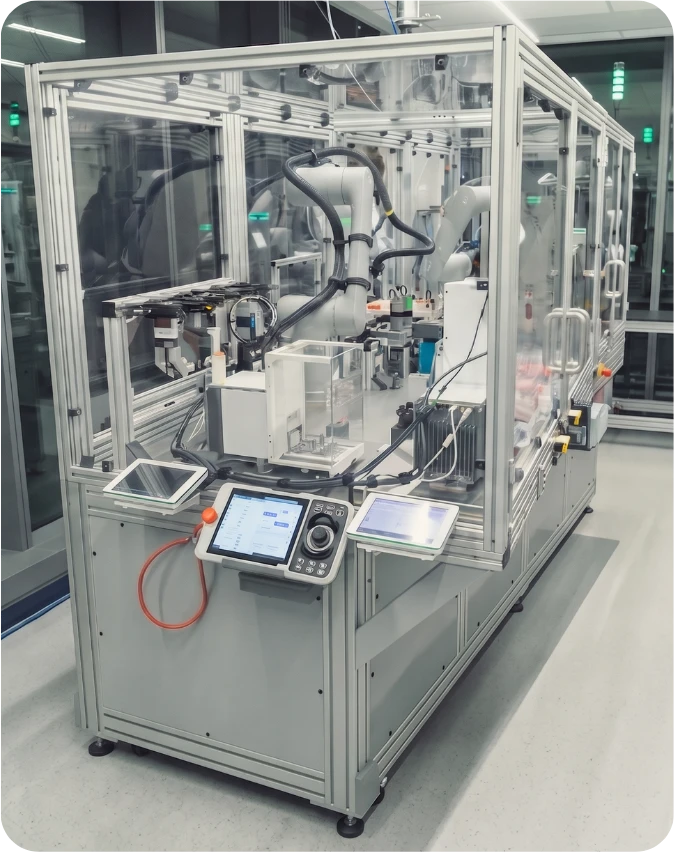
This Self-Driving Labs vision, now a reality, is exactly what the Atinary Lab in Boston is meant to show: two smart robotic platforms that can execute Physical AI-driven experiments in full autonomy, in self-driving mode.
The facility focuses on accelerating small molecule synthesis and catalysis, specifically targeting key complex chemical reactions like Buchwald-Hartwig and Suzuki couplings.
The Era of Exponential Catalysis
The urgency of global challenges, from health challenges to climate change to materials autonomy, calls for a departure from the linear R&D cycles of the past. When catalysis research is no longer limited by manual trial-and-error, it enters the realm of exponential science.
By bringing Self-Driving Labs® into the heart of the workflow, we aren’t just speeding up the process; we are creating a persistent data flywheel where every experiment, regardless of whether it yields a high-performing or a low-performing catalyst, is deeply informative and strengthens the underlying model. Problems that were previously too complex or resource-intensive to pursue become tractable. The researcher’s role shifts from manual operator to strategic architect.
Self-Driving Labs® don’t replace scientists; they augment them. By elevating scientists above the repetitive mechanics of trial-and-error, leveraging AI and robotics so that expertise goes where it creates the most value: creativity, reasoning, and the decisions that move a program forward at the pace the 21st century requires.
Ultimately, this paradigm shift is about more than just incremental gains. It is about permanently transforming catalysis R&D with data-driven workflows to unlock the sustainable solutions of tomorrow.
By bringing Self-Driving Labs® into the heart of the workflow, we aren’t just speeding up the process; we are creating a persistent data flywheel where every experiment, regardless of whether it yields a high-performing or a low-performing catalyst, is deeply informative and strengthens the underlying model. Problems that were previously too complex or resource-intensive to pursue become tractable. The researcher’s role shifts from manual operator to strategic architect.
Self-Driving Labs® don’t replace scientists; they augment them. By elevating scientists above the repetitive mechanics of trial-and-error, leveraging AI and robotics so that expertise goes where it creates the most value: creativity, reasoning, and the decisions that move a program forward at the pace the 21st century requires.
Ultimately, this paradigm shift is about more than just incremental gains. It is about permanently transforming catalysis R&D with data-driven workflows to unlock the sustainable solutions of tomorrow.
Author Contributions
Edlyn Wu, PhD (Scientific Solutions Associate)
Edlyn Wu, PhD (Scientific Solutions Associate)
About Atinary
Atinary are the pioneers of Self-Driving Labs®, augmenting scientists with AI and Robotics to accelerate R&D from years to week. Under the leadership of Dr. Hermann Tribukait and Dr. Loïc Roch, working together since 2017, we are taking our mission to the next level with our new Atinary Lab in Boston. The era of exponential science is here.
Atinary are the pioneers of Self-Driving Labs®, augmenting scientists with AI and Robotics to accelerate R&D from years to week. Under the leadership of Dr. Hermann Tribukait and Dr. Loïc Roch, working together since 2017, we are taking our mission to the next level with our new Atinary Lab in Boston. The era of exponential science is here.