
An exploration of why AI entered chemistry, how it changes workflows, and its practical impact on chemists’ roles.
Modern chemistry R&D is shifting rapidly: the search spaces are simply too large, and human intuition alone cannot navigate it. A reaction optimization or single process optimization can involve billions of possible parameter combinations. Traditional trial-and-error, no matter how experienced the team, leaves most of that space unexplored.
Artificial intelligence (AI) doesn’t eliminate the R&D bottlenecks, but rather minimizes them and makes them tractable. It’s not about replacing chemists with AI, but augmenting the scientists and building the human-AI workflows, with or without robotics, that accelerate discovery without sacrificing scientific rigor or control.
These advances are powered by machine learning, deep learning, and increasingly generative AI, which improve how chemists approach complex problems across drug discovery and materials research.
In this blog post, we map out what those workflows look like in practice: where AI adds the most value, how chemists’ roles evolve, and what it takes for chemists and AI to work in tandem.
Artificial intelligence (AI) doesn’t eliminate the R&D bottlenecks, but rather minimizes them and makes them tractable. It’s not about replacing chemists with AI, but augmenting the scientists and building the human-AI workflows, with or without robotics, that accelerate discovery without sacrificing scientific rigor or control.
These advances are powered by machine learning, deep learning, and increasingly generative AI, which improve how chemists approach complex problems across drug discovery and materials research.
In this blog post, we map out what those workflows look like in practice: where AI adds the most value, how chemists’ roles evolve, and what it takes for chemists and AI to work in tandem.
Key Takeaways
- Human-AI collaboration improves decision quality in chemistry R&D by pairing algorithmic pattern recognition with expert judgment.
- AI excels at predicting outcomes, prioritizing experiments, and modeling complex trade-offs.
- Chemists set objectives, apply domain expertise, and validate results.
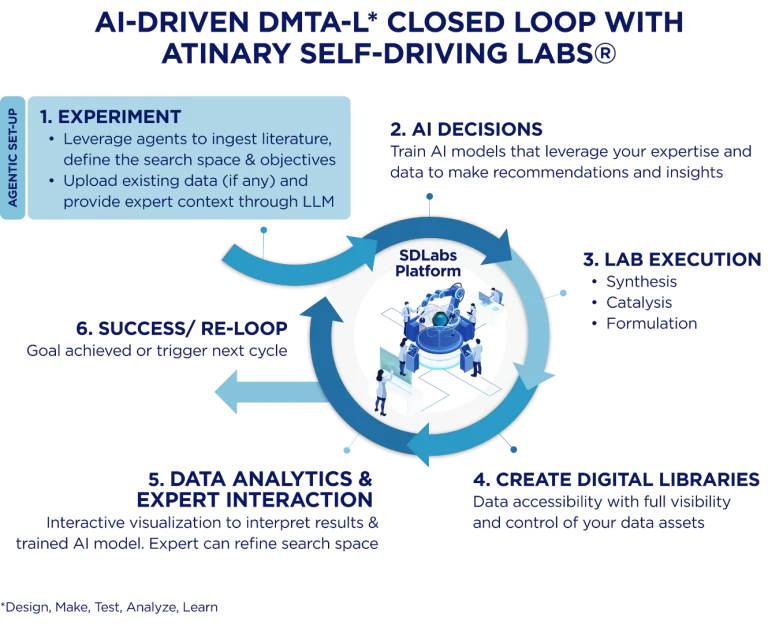
- Closed-loop DMTA-L workflows reach robust operating points with fewer experiments and clearer uncertainty estimates.
- Hybrid digital twins that combine first principles and data-driven models expose scale-up risks before pilot runs.
- Adoption requires disciplined practices: diverse seed sampling, model validation, operational guardrails, and transparent audit trails.
The rise of AI in modern chemistry research
Chemistry R&D has reached a point where the bottleneck is no longer running experiments, but deciding what to run next. High-throughput systems generate more data than teams can manually interpret, while experimental spaces expand into millions or billions of combinations. This shift from data scarcity to data abundance is why AI is entering the lab now.
Modern AI systems can process large datasets of molecular structures and predict outcomes across vast chemical spaces, enabling faster progress in molecular design and understanding of material properties.
Think of it like a self-driving car: the system optimizes the route, but the driver sets the destination. In a Self-Driving Lab, AI explores the design space and suggests next steps, while the scientist defines objectives, applies constraints, and interprets results. Choosing what to optimize and which trade-offs matter requires context that no AI model can infer.
AI earns its place in tasks that don’t scale for humans: detecting patterns in high-dimensional data, predicting reaction outcomes before experiments, and navigating complex trade-offs. It turns vast search spaces into guided exploration.
Modern AI systems can process large datasets of molecular structures and predict outcomes across vast chemical spaces, enabling faster progress in molecular design and understanding of material properties.
Think of it like a self-driving car: the system optimizes the route, but the driver sets the destination. In a Self-Driving Lab, AI explores the design space and suggests next steps, while the scientist defines objectives, applies constraints, and interprets results. Choosing what to optimize and which trade-offs matter requires context that no AI model can infer.
AI earns its place in tasks that don’t scale for humans: detecting patterns in high-dimensional data, predicting reaction outcomes before experiments, and navigating complex trade-offs. It turns vast search spaces into guided exploration.
AI workflows that improve productivity and decision quality
The most useful AI workflows in chemistry do not start with automation for its own sake. They start with the scientist’s daily bottlenecks: setting up experiments, making sense of data, and connecting the lab’s existing tools.
Beyond the Blank Slate
A strong workflow begins before the first run. AI tools and agentic workflows can reduce the setup burden by pulling in external or internal knowledge, searching literature, leveraging existing data acquired from the lab, and defining a clear experiment plan and optimization campaign. Instead of treating each project as a blank slate, the model learns from prior runs, exposing the relationships between variables and outcomes, and showing which regions of the space deserve attention first. This is particularly relevant in drug development, where prior experimental data can guide the selection and prioritization of drug candidates more efficiently.
The Human-AI Exchange
Scientists often want to interact with the algorithm, especially when data is sparse. Human priors, intuition, and known chemical relationships can guide the search while the model remains data-driven. That two-way exchange, combining expert judgment with AI insights and data analysis, helps avoid the cold-start problem and makes the recommendations easier to trust.
Fitting the Lab as It Is
Finally, the workflow has to fit the lab as it is. Not every team works with the same automation stack. Some labs are manual. Others are semi-automated or already robotic. A practical platform should connect to the existing software and hardware ecosystem instead of forcing the lab to adapt around it.
A strong workflow begins before the first run. AI tools and agentic workflows can reduce the setup burden by pulling in external or internal knowledge, searching literature, leveraging existing data acquired from the lab, and defining a clear experiment plan and optimization campaign. Instead of treating each project as a blank slate, the model learns from prior runs, exposing the relationships between variables and outcomes, and showing which regions of the space deserve attention first. This is particularly relevant in drug development, where prior experimental data can guide the selection and prioritization of drug candidates more efficiently.
The Human-AI Exchange
Scientists often want to interact with the algorithm, especially when data is sparse. Human priors, intuition, and known chemical relationships can guide the search while the model remains data-driven. That two-way exchange, combining expert judgment with AI insights and data analysis, helps avoid the cold-start problem and makes the recommendations easier to trust.
Fitting the Lab as It Is
Finally, the workflow has to fit the lab as it is. Not every team works with the same automation stack. Some labs are manual. Others are semi-automated or already robotic. A practical platform should connect to the existing software and hardware ecosystem instead of forcing the lab to adapt around it.
Real-world example of decision-augmented chemistry
The discovery of new materials or molecules is a search problem too large for brute-force chemistry alone. Global challenges that span societal, environmental, economic, and health needs require a pace of discovery that limited experimental capacity cannot meet.
In the study by Stokes et al., a neural network was trained on a relatively small experimental dataset and applied to more than 107 million virtual molecules. By using the model to narrow the search to a handful of candidates, they identified halicin, a potent antibacterial compound. This structurally distinct molecule showed broad activity against resistant pathogens, demonstrating how AI can surface leads that manual review would miss.
Atinary is also exploring how transfer learning can extend optimization beyond single reactions. In collaboration with the synthetic chemistry team at NYU Abu Dhabi (lab of Prof. Alan Healy), the focus was on a long-standing challenge: identifying reaction conditions that generalize across different substrates. Instead of relying solely on literature precedents, the team built a compact, domain-specific dataset guided by expert knowledge of the reaction space. By incorporating this prior information through transfer learning, the system was able to propose effective conditions for new substrates in only a few experiments, showing how past knowledge can accelerate exploration in unfamiliar spaces. Details here.
Summarizing: predictive models can turn an impossibly large design space into a focused set of hypotheses, leaving scientists to validate and interpret the best options. This is the same loop predictive process design that aims to create in life sciences, materials science, and chemistry.
If you are wondering if AI-generated results are trustworthy: the most reliable outcomes come from workflows where AI proposes, and humans validate—ensuring that predictions translate into reproducible, physically meaningful results.
In the study by Stokes et al., a neural network was trained on a relatively small experimental dataset and applied to more than 107 million virtual molecules. By using the model to narrow the search to a handful of candidates, they identified halicin, a potent antibacterial compound. This structurally distinct molecule showed broad activity against resistant pathogens, demonstrating how AI can surface leads that manual review would miss.
Atinary is also exploring how transfer learning can extend optimization beyond single reactions. In collaboration with the synthetic chemistry team at NYU Abu Dhabi (lab of Prof. Alan Healy), the focus was on a long-standing challenge: identifying reaction conditions that generalize across different substrates. Instead of relying solely on literature precedents, the team built a compact, domain-specific dataset guided by expert knowledge of the reaction space. By incorporating this prior information through transfer learning, the system was able to propose effective conditions for new substrates in only a few experiments, showing how past knowledge can accelerate exploration in unfamiliar spaces. Details here.
Summarizing: predictive models can turn an impossibly large design space into a focused set of hypotheses, leaving scientists to validate and interpret the best options. This is the same loop predictive process design that aims to create in life sciences, materials science, and chemistry.
If you are wondering if AI-generated results are trustworthy: the most reliable outcomes come from workflows where AI proposes, and humans validate—ensuring that predictions translate into reproducible, physically meaningful results.
Future outlook
As human-AI collaboration matures, the skill set of the chemist continues to evolve. Rather than turning chemists into programmers, these workflows shift focus toward interpreting model outputs, framing better experimental questions, and guiding research direction. Tools designed with accessibility in mind allow scientists to engage with advanced methods without needing deep ML expertise from day one.
What AI Will Not Replace:
What AI Will Not Replace:
- Intuition: Built through experience and creative hypothesis design.
- Scientific Judgment: Knowing when a result does not make scientific or practical sense.
- Ethics: Ensuring the goals of research align with human and planetary needs.
AI contributes pattern recognition and optimization at scale, but human oversight ensures the results are valid. The most effective teams treat AI as a collaborator that augments reasoning rather than replacing it.
The Era of Exponential Science
Atinary’s Co-Founders, Dr. Hermann Tribukait and Dr. Loïc Roch, coined the term Self-Driving Labs® in 2017 following their leadership of a global initiative on accelerating materials discovery. The core insight then, and now, is that the most effective R&D systems don’t automate scientists out of the process, but rather they free scientists from the repetitive, manual, and computationally intractable parts of it, so their expertise goes where it matters most: creativity, judgment, and innovation. This transformation is the foundation of Exponential Science.
The chemist’s role doesn’t diminish in an AI-driven R&D lab. The question shifts from “which experiments should I run?” to “what does this data tell me, and where should science go next?” That’s a more interesting problem and a more productive one.
The chemist’s role doesn’t diminish in an AI-driven R&D lab. The question shifts from “which experiments should I run?” to “what does this data tell me, and where should science go next?” That’s a more interesting problem and a more productive one.
“Self-Driving Labs are about bringing AI into contact with reality. By closing the loop between experiment design, physical execution, and learning, we enable science to progress at a fundamentally different pace. Our Boston lab is a blueprint for how R&D will be done in the future, where human insight and machine intelligence work together to unlock discoveries that would otherwise take decades.”
— Dr. Hermann Tribukait, Co-Founder & CEO, Atinary