Customer
Lab of Tonio Buonassissi (MIT)
Context
Metal halide perovskite solar cells (PSCs) are among the most promising candidates for next-generation, high-efficiency, low-cost solar energy. Yet a persistent reproducibility crisis continues to block their commercialization. Film crystallization is exquisitely sensitive to ambient conditions during fabrication, with temperature, humidity, and solvent vapor pressure all shaping device performance, and these factors are routinely under-reported or uncontrolled in the literature.
For the Buonassisi Lab at MIT, this represented not just a scientific question, but an urgent practical challenge. With a four-week window, how do you rigorously characterize a high-dimensional environmental space under real research constraints, without a machine learning team on hand?
“This study was infeasible under the deadline with available in-house capabilities.
Dr. Tonio Buonassisi, Professor and Principal Investigator at MIT, now VP of Sustainable Energy at CSEM
From first meeting to results in a few weeks. We would not have been able to solve this complex optimization project without Atinary.
The ROI was infinite for us!”
Challenge
The team faced a combination of factors that made traditional experimentation untenable:
- Nonlinear, coupled interactions: Temperature, humidity, and solvent vapor pressure do not act independently. Their interactions create a complex, non-additive optimization landscape that one-factor-at-a-time (OFAT) methods fundamentally cannot resolve.
- Combinatorial Explosion: Exploring a 5-dimensional environmental parameter space (absolute humidity, temperature, and solvent partial pressure across spin-coating and annealing stages) using OFAT or grid-search methods would be impractically slow and resource-intensive.
- No coding expertise on hand: Implementing Bayesian Optimization (BO) from scratch requires significant coding and ML knowledge. expertise the team needed to direct elsewhere, toward running precise and consistent experiments.
- Hard deadline: The project kicked off on November 20, 2024, with a four-week deadline.
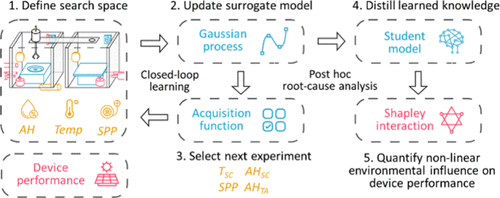
Closed-loop active learning framework for optimizing multi-dimensional search space with five environmental parameters.
Figure from publication (Liu et al. ACS Energy Lett. 2026)
Solution
The Buonassisi Lab deployed Atinary’s SDLabs AI platform to run a closed-loop Bayesian optimization campaign without the need for coding.
- Code-free BO via SDLabs: Researchers accessed Atinary’s proprietary Gaussian Process Bayesian Optimization algorithm through an intuitive, code-free interface, allowing them to focus entirely on the experimental work.
- Closed-Loop Active Learning: The platform iteratively learned from experimental results, recommending the most informative next conditions. The campaign comprised one initial sampling round followed by four active-learning cycles, for 33 experiments in total across five rounds.
- Interpretable AI with Shapley interaction analysis: By integrating Shapley interaction analysis, the platform helped the team quantify how different environmental variables interact and compensate for one another, turning optimization results into mechanistic insight about film formation.
“Bayesian Optimization is not something you can just pick up in an hour.
Dr. Nicky Evans, Postdoc in the Buonassisi Lab, MIT
[…] to have software that can provide a package to you that saves you all the time learning and tweaking your code is a huge time saver. ”
Business Impact
| 33 Experiments to explore a 5D environmental parameter space | 4 weeks Full optimization campaign delivered on deadline | 5 Experimental rounds: 1 initial sampling + 4 active-learning cycles |
- Efficient exploration of a high-dimensional space: The team mapped the impact of environmental variables on device performance in just 33 experiments, while capturing the critical nonlinear interactions that single-variable methods would have missed entirely.
- Discovery of a key environmental coupling: The campaign revealed that solvent vapor only harms device efficiency when ambient humidity is simultaneously high, a nonlinear interaction invisible to conventional methods, with direct implications for manufacturing environment design.
- Accelerated Research Cycle: Eliminated the “coding barrier,” allowing the research team to focus entirely on experimental execution rather than ML implementation.
- Enhanced Robustness: Provided a generalizable framework for “fingerprinting a given recipe’s environmental sensitivities”, directly enabling more reproducible and uniform manufacturing of perovskite modules.
Resources
Link to Publication: Liu et al. Disentangling Environmental Effects on Perovskite Solar Cell Performance via Interpretable Machine Learning. ACS Energy Lett. 2026, 11, 2, 1609–1617, https://doi.org/10.1021/acsenergylett.5c02410
Behind the Science: Read our interview with the MIT researchers on AI-Driven Experimentation in their Solar Cell Research