
The same is true in drug discovery and product development. For years, scientific R&D was hampered by siloed data, manual record-keeping, and slow experimental cycles. Today (2026), the labs and organizations that invested early in digital transformation, moving from paper to databases, from standalone tools to cloud platforms, have finally enabled AI to scale progress. This means faster discovery cycles, more reliable results, and smarter decision support across the R&D pipeline. AI didn’t transform labs overnight. It amplified what was already connected.
● When structured data, integrated workflows, and scalable compute come together, AI becomes a true acceleration engine.
● The labs that align technology with culture and scientific judgment will not just move faster — they will decide better.
Scientific R&D before AI
Reproducibility suffered as a result. A 2016 Nature survey of 1,576 researchers found that more than 70% had failed to reproduce another scientist’s experiments (see figure below). Decisions relied on intuition because the infrastructure to run systematic loops reliably simply did not exist.
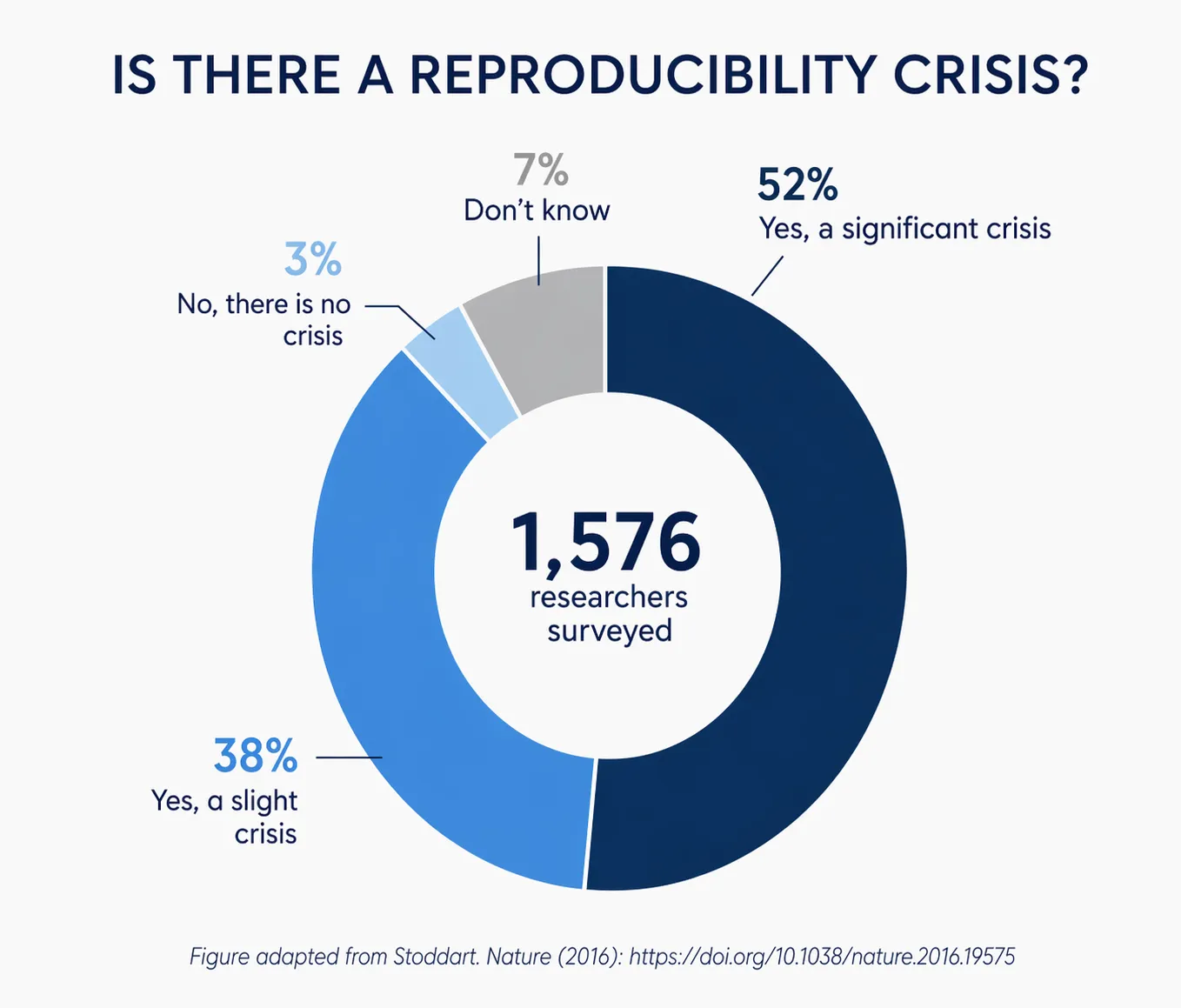
“Fragmented data makes it harder to find, access, integrate, and reuse results, so AI and analytics underperform when datasets are incomplete or siloed.”
Digital transformation as the foundation for AI adoption
- Is your data traceable?
Every sample should must include metadata (who ran it, under what conditions, with what outcome) so that ML models can learn from both historical successes and failures rather than starting from scratch on every project. - Is your compute scalable?
The shift toward cloud-native architectures on platforms like AWS has replaced the limitations of legacy on-premise servers. This transition allows labs to process complex experimental datasets in near real-time, providing the “burst” capacity needed for high-dimensional optimization. - Is your data interoperable?
Formalizing data as Findable, Accessible, Interoperable, and Reusable (FAIR) ensures it is machine-readable across systems, teams, and time. And ready for the ML era.
The R&D timeline (2010–2026)
| Era (years) | Organizational strategy | Structural evolution: from “old” to “new” | The “2026” impact |
|---|---|---|---|
| Digitization Wave (≈2010–2015) | Establish a paperless mandate and capture protocols digitally | From paper notebooks, binders and filing cabinets → ELNs, LIMS and cloud storage | Data becomes searchable, indexed and centrally discoverable; many organizations run pilot or iterative ELN/LIMS projects |
| Connectivity Wave (≈2016–2020) | Break silos and adopt FAIR principles | From isolated spreadsheets and device logs → FAIR data lakes, standardized schemas and shared APIs | Interoperability rises; instruments, sequences, and records get linked for knowledge sharing and cross-study analysis |
| HTE Surge (mid-2010s to ≈2019) | Invest in robotics, plate readers and parallel execution | From manual entry → high-throughput data streams and lab data warehouses | Data volumes force unified platforms (materials informatics/lab data lakes); data management becomes strategic |
| AI Augmentation (≈2021–2024) | Use ML for prioritization, literature mining and hypothesis ranking | From raw experimental records → curated, AI-ready datasets and predictive surrogates | Models rank promising experiments; teams prioritize information gain instead of brute-force screening |
| Autonomous Era (≈2024–2026) | Move to closed-loop, self-driving labs | From human-driven planning → autonomous iterative cycles linking models to robotics | Fewer iterations to reach targets; scientists remain in the loop, but augmented for more time as a strategic and creative layer |
While the autonomous era is now an industry benchmark, the scientific R&D timeline leading into 2026 reflects a gradual but compounding transformation. This paradigm shift began with pioneers who recognized the convergence of the digital and physical worlds long before 2026.
Early efforts (2015-2020) focused on digitalization — moving from paper records to structured data and cloud-based systems. Between 2020 and 2024, machine learning models began to support specific tasks such as molecule design and reaction optimization. By 2025-2026, these capabilities are converging into integrated, closed-loop systems where AI, automation, and experimental workflows operate together.
Adoption and measurable impact Across disciplines
● Pharma: Takeda Pharmaceuticals integrated AI-Design of Experiments (DoE) with robotics to optimize reaction screening assays, compressing months-long workflows into days, as explored in detail below.
● Materials Science: In collaboration with ETH Zurich’s SwissCat+, our SDLabs AI Platform identified catalyst candidates for CO₂-to-methanol conversion. Across a space of over 20 million possible combinations, we delivered what would have taken 100 years of research in just six weeks — a 1,000x acceleration.
● Life Sciences & Fragrances: In collaboration with dsm-firmenich, Atinary’s AI platform identified optimal parameters in just 88 experiments. This achieved a 30x catalyst reduction & 97% cost reduction in hydroformylation processes.
The path has been similar across many fields. Build on digital data capture, layer in analytics and AI models into experimental workflows — not as a linear progression, but as compounding capabilities that grow more powerful together.
What AI actually changes in scientific workflows
Hypothesis generation
AI scans literature and experimental data to make an enriched data analysis, share insights, and propose new targets.
Experiment prioritization
Given a large set of possible experiments, AI ranks the most promising experiments by their value of information. AI narrows complex design spaces down to a handful of candidates most likely to yield a breakthrough.
Real-time analysis
As experimental results come in, scientists can assess in real time how each run performed against defined objectives and where it lands within the design space. Rather than manually sifting through outputs to decide what to try next, the platform recommends the next move that reflects both the performance of completed runs and the remaining territory worth exploring. This keeps the scientist in the interpretive seat while removing the bottleneck of manual re-planning.
Closing the loop
In our Self-Driving Labs, the next experiment is not just suggested. It is queued, run, and fed back into the model without manual handoff.
Knowledge discovery and sharing
By correlating data across projects, AI can surface insights that would otherwise remain hidden. It can suggest why an experiment failed and what to try next, building knowledge that scales beyond individual researchers.
Labs that get the most out of AI in 2026 tend not to run it in isolation. They embed it into integrated platforms that connect recommendations to execution. As Atinary, we made it through Self-Driving Labs® built with partners that include ABB Robotics, Agilent Technologies, Bruker, Chemspeed, and Mettler Toledo. There, the SDLabs AI platform closes the loop between AI-generated recommendations and physical experimentation. What we call Self-Driving Labs and now Physical AI is a working blueprint for what fully integrated, closed-loop discovery looks like in practice, and shaping the next generation of breakthroughs in science and technology.
Augmenting, not Replacing
It also matters for reliability, because researchers know their domain and catch the kinds of context-specific errors that a general-purpose model would miss. Scientific problems often require judgment calls that go beyond pattern recognition.
For example, two experiments may have similar predicted outcomes, but a scientist knows which one better serves scale-up constraints or regulatory requirements. Scientists are moving from learning how to operate tools to collaborating with AI as a decision-support system.
Overcoming the Barriers to Adoption
Key lessons we have seen:
| Data messiness | Change management | Workflow and technical misalignment |
|---|---|---|
| Some labs still record live in disconnected systems: proprietary instrument exports, ELN entries with inconsistent metadata, and results not linked to the conditions that produced them. Teams underestimate the cleanup work, turning a short sprint into months of remediation. | Scientists often distrust opaque models and resist handing over experimental choices. Adoption depends on clear communication, transparent models, and focused training that frame AI as a decision aid that augments expert judgment. | AI tools that operate as standalone applications, disconnected from the scientist’s daily tools, rarely gain traction. Embedding AI directly into familiar platforms such as ELNs and LIMS has proven critical for sustained adoption. |
What successful, human-first AI adoption delivers
- McKinsey’s 2024 analysis estimated that end-to-end AI integration could remove more than 500 days from drug development timelines.
- Gartner’s 2024 Market Guide for Materials Informatics Solutions identifies AI-driven platforms as directly addressing what it calls “slow steps” in R&D, specific workflow bottlenecks burdened by time and resources. It also positions materials informatics as creating a virtuous cycle of accelerated discovery, selection, and development across industries from specialty chemicals to life sciences.
- A 2023 study by Toner-Rodgers found that AI-assisted materials science teams produced 44% more discoveries and filed 39% more patents than control groups.
These are not isolated wins. They are the product of the same closed-loop approach now embodied in Atinary’s Self-Driving Labs® in Boston — read the opening recap — where AI, robotics, and human expertise operate as a unified system and provide a tangible demonstration of what this infrastructure looks like when fully realized.
The Future is Exponential
The window to build that foundation is now. The labs investing in closed-loop experimentation today are the ones who will define the pace of discovery for the next decade.
Across SwissCat+, Takeda, and other collaborations, we have turned long optimization cycles into data-driven progress. Book a 30-minute technical discussion with our scientists. Let’s explore your goals and assess how AI-driven optimization can accelerate your path to innovation and discovery.
About Atinary
Atinary are the pioneers of Self-Driving Labs®, augmenting scientists with AI and Robotics to accelerate R&D from years to weeks. Under the leadership of Dr. Hermann Tribukait and Dr. Loïc Roch, working together since 2017, we are taking our mission to the next level with our new Atinary Lab in Boston. The era of exponential science is here.