Overview
The collaboration between Atinary and the Swiss national initiative for catalysis known as SwissCat+, based in ETH Zurich, demonstrates the transformative power of AI-driven experimentation. Envisioned by Prof. Christophe Copéret and executed and managed by Dr. Paco Laveille and his team, ETH Zurich’s AI-Driven R&D Lab utilizes Atinary’s SDLabs platform, which guided the AI-driven process to find the optimal catalyst for the conversion of carbon dioxide (CO2) into methanol. This project demonstrates the power of augmenting humans with AI and robotics to solve complex R&D challenges, significantly enhancing efficiency, productivity and success rates while minimizing raw material use and costs.

From Figure 1 of our publication, overview of the presented method workflow and benefits in our use-case in comparison with a conventional approach.
Challenge
Find the best catalyst for the conversion of CO2 to fuels (methanol, MeOH).
By the Numbers
| 11 parameters | 20M+ potential combinations | 7 constraints | 4 objectives |
Outcome
In just 30 days, we replicated major development stages that spanned a century.
- 144 combinations tested (6 iterations, 24 batches per iteration)
- 0.00072% of total combinations tested in the re-discovery of the best catalyst in CO2 conversion to methanol.
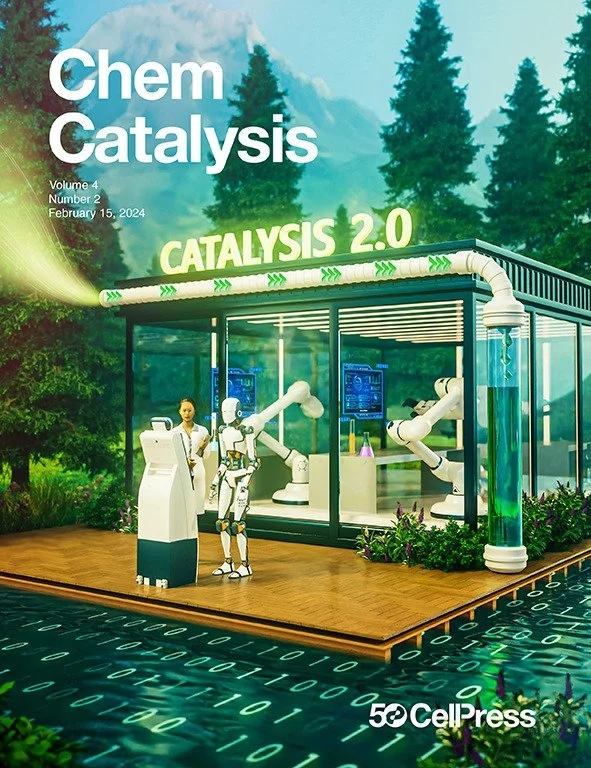
Our joint article was featured on the cover of Cell Press’ Chem Catalysis February issue: Illustration of the new generation of chemistry laboratories where humans interact with robots and artificial intelligence to accelerate the discovery of catalysts that convert pollutants into high-value renewable fuels and chemicals. For more information, see the article by Laveille and co-workers. Art by INMYWORK Studio.
Resources
- Link to Press Release on Atinary-ETH Zurich Partnership
- Link to Publication: Ramirez et al. Accelerated exploration of heterogeneous CO2 hydrogenation catalysts by Bayesian-optimized high-throughput and automated experimentation. Chem Catalysis. 2024 https://doi.org/10.1016/j.checat.2023.100888
- Link to Research Highlight in Nature Catalysis
- Link to Atinary Webinar
- More about ETH Zurich Swiss CAT+
- Download the use case as a pdf: brief overview, in detail
In this video, we demonstrate the capabilities of Atinary’s SDLabs platform during the team’s visit to the AI-driven High-throughput Laboratory at ETH Zurich – from experiment setup and automated synthesis via robotic platforms to data analysis and proposal generation in an iterative closed-loop process. Discover how Atinary’s no-code AI and Self-Driving Labs technology, SDLabs, enhances efficiency and innovation in experimental workflows.